


This report divides the world into five regions to take a closer look at the geographic distribution of Christians. (To view all the countries in each region, see the Interactive Maps.)
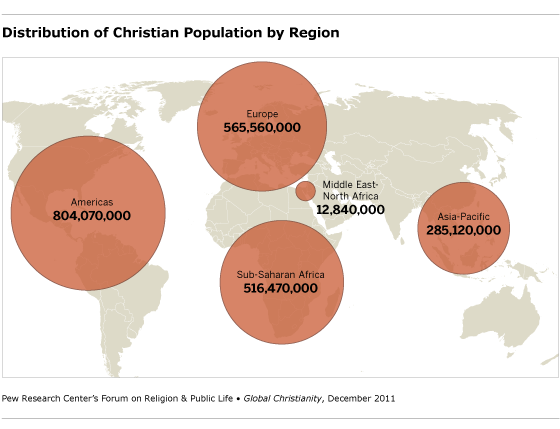
The five regions are presented in descending order of Christian population, with the region with the highest number of Christians (the Americas) appearing first and the region with the lowest number of Christians (the Middle East-North Africa) appearing last.

Americas
(51 COUNTRIES AND TERRITORIES)
Christians living in the Americas make up 37% of Christians worldwide.8 The three countries in the Americas with the largest Christian populations also have the three largest Christian populations in the world: the United States (247 million Christians), Brazil (176 million) and Mexico (108 million). The 10 countries in the Americas with the largest number of Christians collectively are home to a third (33%) of all the world’s Christians.

Nearly two-thirds of Christians in the Americas (65%) are Catholic. Protestants make up a third of all Christians (33%) in the region. About 2% of the region’s Christians fall into the other Christian category, and less than 1% are Orthodox Christians.
 Spotlight on Brazil
More than 175 million Brazilians are Christian, making the country’s Christian population the largest outside the United States. By way of comparison, Brazil has more than twice as many Christians as Nigeria and about three times as many as Germany. Indeed, nearly one-in-twelve Christians in the world (8%) are Brazilian, and an overwhelming majority of Brazilians (90%) identify themselves as Christian.
Since the Portuguese conquest of Brazil in the 16th century, the country has been overwhelmingly Catholic. In 1950, almost 94% of Brazilians identified with Catholicism; as recently as 1980, Catholic affiliation approached 90%. Between 1980 and 2000, however, the Catholic share of Brazil’s population fell by 15 percentage points to 74%.1 Despite the decline, Brazil’s Catholic population of about 134 million remains by far the largest in the world. (Mexico’s Catholic population is a distant second at 96 million.) About one-in-eight Catholics worldwide (12%) are Brazilian.
Catholicism’s historical dominance in Brazil has given way to increasing Christian diversity. In 1940, only 2.6% of Brazil’s population was Protestant.2 Now about 21% of the population is Protestant. This fastgrowing Protestant community is overwhelmingly pentecostal; according to a 2006 Pew Forum survey, 72% of Protestants interviewed indicated they were pentecostal.3 (For more details on pentecostals, see Defining Christian Movements.)
Pentecostal beliefs and practices also are changing the way many of Brazil’s Catholics practice their faith. The 2006 Pew Forum survey found that more than half of Brazilian Catholics identify with the charismatic movement, which includes members of non-pentecostal denominations who engage in at least some spiritual practices associated with pentecostalism, such as divine healing and speaking in tongues.4 (For more details on charismatics, see Defining Christian Movements.)
Footnotes:
1 Figures cited in this sidebar are from Brazil’s national decennial census. For more details on religious trends in Brazil, see Luis Lugo, “Pope to Visit ‘Pentecostalized’ Brazil,” Pew Forum on Religion & Public Life, 2007. (return to text)
2 The figure is from Brazil’s national census. See Emilio Willems, Followers of the New Faith; Culture Change and the Rise of Protestantism in Brazil and Chile, Vanderbilt University Press, 1967, pages 66-67. (return to text)
3 Approximately eight-in-ten Protestants interviewed indicated they were either pentecostal or charismatic. Survey results suggest that the Assemblies of God is the single largest pentecostal church, accounting for four-in-ten pentecostals. The survey was based on a probability sample of Brazilian cities and surrounding areas and excluded rural parts of the country. See Pew Research Center’s Forum on Religion & Public Life, Spirit and Power: A 10-Country Survey of Pentecostals, 2006. (return to text)
4 Pew Research Center’s Forum on Religion & Public Life, Spirit and Power: A 10-Country Survey of Pentecostals, 2006. (return to text)
 Spotlight on the United States
The United States is the world’s third most populous country, but it has by far the largest Christian population. With nearly a quarter of a billion Christians, the U.S. dwarfs even Brazil, which has the world’s second-largest Christian community (more than 175 million). About 80% of the U.S. population identifies as Christian, and U.S. Christians represent 11% of the world’s Christians.Since the birth of the nation in 1776, the vast majority of religious Americans have been Christian. The settlers who colonized the Eastern seaboard between New France in the north and Florida in the south came largely from majority-Protestant Northern Europe, especially England, Scotland, Wales, the Netherlands, Scandinavia and Northern Germany.
American Christianity went from being dominated by a few established Protestant denominations in the founding era to today’s highly diverse mix, with innumerable Protestant groups, a large Catholic population and significant numbers of Orthodox and other Christians. In 1776, the vast majority of Americans active in a religious body belonged to only a handful of Protestant denominations: Congregationalist, Episcopalian, Presbyterian, Baptist and Quaker. By the mid-19th century, however, the picture had changed. The Methodist Church had become by far the largest Protestant denomination by 1850. And before the end of the 19th century, Roman Catholics — who represented a small portion of the population in 1776 and only 5% in 1850 — became America’s largest single Christian group, although Protestants collectively still greatly outnumbered Catholics. By 1906, the U.S. was home to 14 million Catholics, who represented 17% of the population.1 Today, fortified by a steady flow of immigrants from mostly Catholic Latin America, Catholics in the U.S. number more than 74 million, about 24% of the U.S. population. The Southern Baptist Convention is now the largest U.S. Protestant denomination.2
Other factors, too, have diversified America’s religious landscape. Other Christian groups such as Mormons and Jehovah’s Witnesses, many of which were founded in the United States in the 19th century, have grown dramatically and together number nearly 11 million adherents, or about 3% of the U.S. population. The U.S. is also home to nearly 2 million Orthodox Christians. Membership in long-established Protestant churches, such as Congregationalists, Presbyterians, Episcopalians and Methodists, has declined, while membership in newer evangelical and pentecostal churches has grown. Today, the U.S. has more evangelical Protestants than any other country in the world.
At the same time, the proportion of Americans who are Christian has declined in recent years, from well over 90% in 1900 to almost 80% today. This has happened for a variety of reasons, including the growth in “unaffiliated” Americans (atheists, agnostics and those who say they do not have any religion in particular), as well as postwar non-Christian immigration from the Asia-Pacific region and the Middle East-North Africa. In addition, a nation whose population was overwhelmingly Protestant a century ago has had, in recent years, a declining Protestant majority (51% in 2007, according to the Pew Forum’s U.S. Religious Landscape Survey).3
US
1 Historical data in this and the preceding paragraph are drawn from Roger Finke and Rodney Stark, The Churching of America, 1776-2005: Winners and Losers in Our Religious Economy, Rutgers University Press, 2005. (return to text)
2 Pew Research Center’s Forum on Religion & Public Life, U.S. Religious Landscape Survey, conducted in 2007 and published in 2008. (return to text)
3 Pew Research Center’s Forum on Religion & Public Life, U.S. Religious Landscape Survey, conducted in 2007 and published in 2008. (return to text)
Europe

(50 COUNTRIES AND TERRITORIES)
Roughly a quarter of the world’s Christians (26%) live in Europe.9 This makes Europe the region with the second-largest share of the world’s Christians, following the Americas. Russia has the largest absolute number of Christians in Europe (105 million). Despite the Communist government’s attempts to minimize religion in the country for much of the 20th century, more than 70% of Russians are Christian, primarily Orthodox Christian.10 Russia alone accounts for about 19% of Europe’s Christians and nearly 5% of the world’s Christians. Russia and the other nine countries with the largest number of Christians in Europe (Germany, Italy, United Kingdom, France, Ukraine, Spain, Poland, Romania and Greece) collectively are home to one-in-five (20%) of the world’s Christians.


Catholics are the largest Christian group in Europe, accounting for more than four-in-ten European Christians (46%).
The second-largest Christian group in Europe is the Orthodox, who make up 35% of European Christians. The overwhelming majority of the world’s Orthodox Christians (76%) reside in Europe.
Although the Protestant Reformation began in Europe, today fewer than one-in-five European Christians (18%) are part of the Protestant tradition as broadly defined in this report. (See Defining Christian Traditions.)
 Spotlight on Germany
Germany has about 58 million Christians, making it the country with the largest Christian population in Western Europe and second only to Russia in Europe as a whole. Germany’s Christian population is also the ninth-largest in the world. More than 70% of the country’s total population is Christian, divided almost evenly between Protestants and Roman Catholics.
Germanic tribes such as the Goths, Lombards and Franks were gradually converted to Roman Catholicism between roughly the 5th and 8th centuries. The formation of the Holy Roman Empire, beginning in the 10th century, served to consolidate Catholic influence across central Europe.
The 16th-century Protestant Reformation, launched by the German Augustinian monk Martin Luther, divided the territories of what is now Germany into a predominantly Protestant North and a predominantly Catholic South. This division endures today. (States that belonged to East Germany were predominantly Protestant, but they saw a substantial decline in religious adherence during communist rule.)
There are nearly 29 million Protestants in Germany today, accounting for about a third of the overall population, and most are members of the Evangelical Church in Germany (Evangelische Kirche in Deutschland). Roman Catholics account for a third of the German population, totaling about 28 million. Germany also is home to more than a million Orthodox Christians and more than 500,000 other Christians. According to historical estimates, roughly 60% of Germans were Protestant before World War II, and about one-third professed Roman Catholicism. This suggests that the Protestant proportion of the population has declined significantly, whereas the Catholic proportion has remained roughly the same.1
Muslims represent the largest non-Christian religious group in Germany. Germany’s estimated Muslim population in 2010 was about 4.1 million, or about 5% of the total population.2
Footnotes:
1 “Germany,” in David B. Barrett, George Thomas Kurian and Todd M. Johnson, editors, World Christian Encyclopedia, Volume 1: The World by Countries: Religionists, Churches, Ministries, Oxford University Press, 2001, page 299. (return to text)
2 Pew Research Center’s Forum on Religion & Public Life, The Future of the Global Muslim Population: Projections for 2010-2030, 2011. (return to text)
 Spotlight on United Kingdom
Christians are by far the largest religious group in the United Kingdom, representing more than 70% of its population. The U.K.’s Christian population of 45 million is the fourth-largest in Europe and the 12th-largest in the world. The majority of Christians in the United Kingdom are Anglicans. (For more information on Anglicans, see Defining Christian Traditions on page 38.)
Christianity arrived in the British Isles as early as the 1st century. In the late 6th century, Pope Gregory the Great sent a missionary, Augustine, to convert the Anglo-Saxon peoples of Britain. Augustine became the first archbishop of Canterbury and primate of an officially recognized Church of England, in full communion with the pope. Catholic Christianity had become firmly established in England, Scotland and Wales by the time King Henry VIII declared his supremacy over the English church in 1534. While the eventual result of the English Reformation was that most of the English people came to adhere to Anglicanism, a minority remained loyal Catholics or joined “non-conformist” groups that rejected the official church as insufficiently reformed.1
Though the United Kingdom’s population remains predominantly Christian, surveys and censuses indicate that a declining share of the population identifies as Christian. For example, the Annual Population Survey conducted by Britain’s Office of National Statistics found that the proportion of people professing Christianity fell from about 78% in 2004-2005 to about 72% in 2008.2
Footnotes:
1 “UK of Great Britain & Northern Ireland,” in David B. Barrett, editor, World Christian Encyclopedia: A Comparative Study of Churches and Religions in the Modern World, AD 1900-2000, Oxford University Press, 1982, pages 699-703. (return to text)
2 Each round of the Annual Population Survey had a sample size of more than 300,000 people. The survey does not include data from Northern Ireland. (return to text)

Straddling Europe and Asia, Russia could be considered the most populous Christian-majority country on both continents. But for the purposes of this report, Russia is considered a European nation. Its 105 million Christians constitute the world’s fourth-largest Christian population (and the single largest outside the Americas). About 5% of the world’s Christians live in Russia. Moreover, Russia is home to the largest autocephalous (or ecclesiastically independent) Eastern Orthodox Church in the world, the Russian Orthodox Church.1
Byzantine monks first introduced Christianity into Russia in the 9th century. Following his baptism in 988, Vladimir I, the prince of Kiev, led his people into Christianity. The Eastern Orthodox Church has remained the largest religious institution in Russia despite monumental changes in the country’s political system, from monarchy, to Soviet communism, to the current parliamentary and presidential system. Today, a little more than 70% of Russia’s population identifies as Orthodox.2
While Orthodox Christianity is still the dominant religion in Russia, other Christian traditions have grown in recent decades. Outside of the Orthodox Church, Protestants constitute the largest Christian group, with nearly 3 million adherents. A large segment of the Russian population does not identify as Christian, including many who are unaffiliated with any particular religion. According to a 2011 Pew Forum report, Russia has the largest Muslim population in Europe (in absolute numbers).3
Footnotes:
1 “Orthodox, 1910-2010,” in Todd M. Johnson and Kenneth R. Ross, editors, Atlas of Global Christianity, Edinburgh University Press, 2009, page 86. (return to text)
2 Harold Berman, “Freedom of Religion in Russia,” in John Witte and Michael Bourdeaux, editors, Proselytism and Orthodoxy in Russia: The New War for Souls, Orbis Books, 1999, page 266.(return to text)
3 The Pew Forum’s January 2011 report, The Future of the Global Muslim Population, found that, as of 2010, there were 16.4 million Muslims in Russia. See Pew Research Center’s Forum on Religion & Public Life, The Future of the Global Muslim Population: Projections for 2010-2030, 2011.(return to text)
Sub-Saharan Africa
(51 COUNTRIES AND TERRITORIES)
Sub-Saharan Africa has more than 500 million Christians, which makes it the region with the third-largest number of Christians worldwide.11 Collectively, the region’s 51 countries and territories are home to nearly a quarter of the world’s Christians (24%).
Together, the 10 countries with the largest number of Christians in sub-Saharan Africa have about one-in-six of the world’s Christians.


The majority of Christians in sub-Saharan Africa are Protestant (57%), as broadly defined in this report; this includes members of African Independent Churches and Anglicans.12 About one-in-three Christians in the region (34%) are Catholic. Orthodox Christians account for about 8% of the region’s Christians, and other Christians make up the remaining 1%.
 Spotlight on Nigeria
Nigeria is sub-Saharan Africa’s most populous country and is home to the region’s largest Christian population. The West African nation has more than 80 million Christians, who account for about half of the country’s total population. There are more Christians in Nigeria than in any single nation in traditionally Christian Western Europe.1 In fact, Nigeria’s Christian population is nearly the same size as the total population of Germany. Nigeria’s Muslim population is nearly equal to its Christian population; according to the Pew Forum’s 2011 analysis of the global Muslim population, there were about 76 million Muslims in Nigeria in 2010.2
Because the proportion of Muslims and Christians in Nigeria is a sensitive political issue, the national census has not asked questions about religion since 1963.3 In 1953, 21.4% of Nigeria’s population was Christian, 45.3% was Muslim and 33.3% belonged to other religions, including African traditional religions. By 1963, the percentage of the population that belonged to other religions had declined by 15 points, nearly matching the 13.1-point increase for Christians. During this same period, the percentage of Muslims increased by less than 2 points.4 Christians have since increased in number and share to become about half of the population.
Nigeria’s large Christian community is diverse. It includes nearly 60 million Protestants (broadly defined), about 20 million Catholics and more than 750,000 other Christians. All of Christianity’s major groups have grown in Nigeria since the 1970s, but the growth of pentecostal churches has been especially dramatic in recent decades.5
Footnotes:
1 For the purposes of this report, traditionally Christian Western Europe includes the following countries: Austria, Belgium, Denmark, Finland, France, Germany, Greece, Ireland, Italy, Luxembourg, the Netherlands, Norway, Portugal, Spain, Sweden, Switzerland and the United Kingdom. (return to text)
2 Pew Research Center’s Forum on Religion & Public Life, The Future of the Global Muslim Population: Projections for 2010-2030, 2011. (return to text)
3 Pew Research Center’s Forum on Religion & Public Life, Spirit and Power: A 10-Country Survey of Pentecostals, 2006. (return to text)
4 Pew Research Center’s Forum on Religion & Public Life, Spirit and Power: A 10-Country Survey of Pentecostals, 2006, page 85. (return to text)
5 Allan Anderson, An Introduction to Pentecostalism: Global Charismatic Christianity, Cambridge University Press, 2004, pages 159-161. (return to text)
 Spotlight on Ethiopia
Ethiopia has the third-largest Christian population in sub-Saharan Africa, after Nigeria and the Democratic Republic of the Congo. Ethiopia has had a significant Christian presence since the establishment of the Ethiopian Orthodox Church in the early 4th century. Since that time, the Orthodox Church has remained Ethiopia’s most influential religious body, with strong links between church, state and national identity.1 Today, the country’s Christians represent about 63% of the population. Muslims constitute the largest non- Christian group, accounting for about a third of the population.2 Ethiopia’s Christian community dates back to the early 4th century, when the emperor of the Ethiopian Axumite Kingdom converted to Christianity. After the emperor’s conversion, the patriarch of Alexandria in Egypt appointed a bishop to oversee a new church in Ethiopia. The Ethiopian Orthodox Church remained under the oversight of Egyptian Orthodox bishops of the Coptic Church until 1959, when it came under an Ethiopian patriarch. Like the Coptic Church and other Oriental Orthodox churches, the Ethiopian Orthodox Church teaches that Christ has one indivisible nature rather than two separate natures, divine and human (see Defining Christian Traditions on page 38). One of the world’s oldest churches, the Ethiopian Orthodox Church has its own liturgical language and calendar.3 The vast majority of Ethiopia’s Christians have adhered to the Ethiopian Orthodox Church for most of the past 1,700 years.4 Significant diversity has begun to characterize Ethiopia’s Christian population only in the last 25 years.5 Protestants and Catholics combined accounted for less than 5% of the population as recently as 1980.6 Today, however, the groups classified in this report as Protestant — including Anglicans and members of African Independent Churches — represent nearly 20% of all Ethiopians and 30% of the country’s Christians. Roman Catholics make up less than 1% of Ethiopia’s total population.
Footnotes:
1“Ethiopian Orthodox church,” in The New Encyclopaedia Britannica, Volume 4, Encyclopaedia Britannica, Inc., 2007, page 581. (return to text)
2 Pew Research Center’s Forum on Religion & Public Life, The Future of the Global Muslim Population: Projections for 2010-2030, 2011. (return to text)
3 Getnet Tamene, “Features of the Ethiopian Orthodox Church and the Clergy,” in Asian and African Studies, Volume 7, Issue 1, 1998, pages 87-104; “Ethiopia,” in David B. Barrett, editor, World Christian Encyclopedia: A Comparative Study of Churches and Religions in the Modern World, AD 1900-2000, Oxford University Press, 1982, page 284. (return to text)
4 “Ethiopia,” in David B. Barrett, editor, World Christian Encyclopedia: A Comparative Study of Churches and Religions in the Modern World, AD 1900-2000, Oxford University Press, 1982, pages 283-284. (return to text)
5 “Ethiopia,” in David B. Barrett, George Thomas Kurian and Todd M. Johnson, editors, World Christian Encyclopedia, Volume 1: The World by Countries: Religionists, Churches, Ministries, Oxford University Press, 2001, page 266. (return to text)
6 “Ethiopia,” in David B. Barrett, editor, World Christian Encyclopedia: A Comparative Study of Churches and Religions in the Modern World, AD 1900-2000, Oxford University Press, 1982, page 283. (return to text)
Asia-Pacific
(60 COUNTRIES AND TERRITORIES)
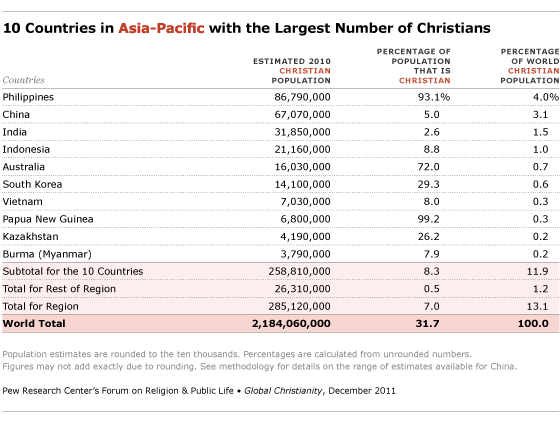
The Asia-Pacific region includes 13% of the world’s Christians.13 The region’s largest Christian population in absolute numbers is in the Philippines, a country that is overwhelmingly Christian (93%). Christians make up a minority of the population in China (5%), India (3%) and Indonesia (9%), but because these countries have very large populations, their Christian minorities are large in number. Collectively, the 10 countries with the largest Christian populations in the region are home to 12% of all Christians worldwide.

Slightly less than half of Christians in the Asia-Pacific region (49%) are Protestant, as broadly defined in this report (see Defining Christian Traditions). Most of the remaining Christians in the region are Catholic (46%), while 4% are Orthodox. About 1% belong to other Christian traditions.
 Spotlight on China
China, the world’s most populous country, is home to the world’s seventh-largest Christian population. (For details on this study’s multi-sourced estimate for China, see Appendix C [PDF].) In the Asia-Pacific region, only the Philippines has a larger Christian population. Mainland China has roughly 67 million Christians, representing about 5% of the country’s total population.1 China is home to the world’s largest number of Christians living as a minority. (See Living as Majorities and Minorities.)
As recently as three decades ago, few researchers even within mainland China knew whether religion had survived the Cultural Revolution (1966-1976) initiated by Chairman Mao Zedong. It is clear now, however, that religion not only survived but that hundreds of millions of Chinese today have some religious faith, including tens of millions of Christians. Visible in nearly every major Chinese city are the steeples of churches affiliated with one of the two state-approved and state-regulated Christian associations: the Protestant Three-Self Patriotic Movement and the Patriotic Catholic Association. Both associations operate their own seminaries, employ thousands of clergy and are served by the Amity Printing Company in Nanjing, which prints more than 10 million Bibles annually.
Despite these visible manifestations of Chinese Christianity, there are significant challenges in estimating its actual size. Published estimates range from about 1% of the population in some relatively smallsample public opinion surveys to about 8% based on reviews of church membership reports.2 Indeed, the estimate offered in this study (5%) is only an approximate one. (See Appendix C [PDF] for more details.)
A precise figure for the number of Christians in China is difficult to nail down because, aside from the fact that China does not ask about religion on its census, there is no fully representative survey of China’s 1.3 billion people. A further complication is that a substantial number of Christians worship in independent, unregistered churches. These churches do not have legal status because they have not affiliated with one of the two officially approved associations. Unregistered independent Protestant churches, often referred to as “house churches,” meet in various venues including homes, rented facilities, businesses and even public places. Additionally, a substantial number of Catholics worship in unregistered congregations that refuse to join the Patriotic Catholic Association. A main point of contention is that the Association operates independently from Rome; for instance, it appoints bishops without the approval of the pope.
Unregistered churches in China operate in what Purdue University Professor Fenggang Yang refers to as “grey” or “black” religious marketplaces.3 In practice, unregistered churches are forced to operate on the edges of the law. This is because there are few specific laws that clearly establish the limits and freedoms of religious groups in society.4 Because of the ambiguous, and sometimes adversarial, relationship between the government and Christian groups that are not willing to join the state-approved associations, attempts to measure the size of these
groups can be met with suspicion by all sides.
As noted above, this study’s review of numerous research sources suggests that Christians make up approximately 5% of China’s population, numbering about 67 million. Of these, roughly 9 million (0.7% of China’s total population) are Catholics, including 5.7 million who are affiliated with the state-approved Patriotic Catholic Association and a conservatively estimated 3.3 million who are affiliated solely with unregistered Catholic congregations. The exact number of Catholics in unregistered congregations is difficult to estimate because there may be double counting in some Catholic dioceses where churches and bishops are affiliated with both the official and unofficial churches. For instance, Beijing Archbishop Joseph Li Shan is recognized by both the Chinese Patriotic Catholic Association and the Vatican.
Christians affiliated with the state-approved Protestant Three-Self Patriotic Movement number roughly 23 million (1.7% of the total population). This study estimates that an additional 35 million Christians in China (2.6% of the population) are affiliated with unregistered churches or attend state-approved churches without having formal membership. Additionally, there are small populations of Orthodox Christians and other Christians, some of whom are expatriates.
The general consensus among scholars of religion in China is that Christianity has grown substantially during the past three decades. It is too soon to know, however, whether Christianity’s growth has peaked or will continue in the years ahead. Whichever turns out to be the case, the religious future of the world’s most populous country will have a major impact not only on Christianity but on other religious traditions as well. (Additional information on the religious situation in China is included in Appendix C: Methodolgy for China [PDF].)
Footnotes:
1 This study includes separate estimates for Hong Kong, Macau and Taiwan. (return to text)
2 Pew Research Center’s Forum on Religion & Public Life, Religion in China on the Eve of the 2008 Beijing Olympics, 2008. (return to text)
3 Fenggang Yang, “The Red, Black, and Gray Markets of Religion in China,” The Sociological Quarterly, Volume 47, 2006, pages 93–122. (return to text)
4 For an overview of China’s restrictions on religion in a global context, see Pew Research Center’s Forum on Religion & Public Life, Rising Restrictions on Religion, 2011. (return to text)
 Spotlight on the Philippines
The Philippines has the fifth-largest Christian population in the world, with about 87 million Christians. Indeed, the Philippines has the largest Christian population outside of the Americas and Europe. It also has the third-largest Catholic population in the world (at about 76 million), behind Brazil and Mexico and slightly ahead of the U.S. Catholic population. (See table in Catholic.)
Roman Catholic priests and missionaries began arriving in the Philippines in the 16th and 17th centuries, around the time of the Spanish conquest of the country. The church steadily gained adherents over the centuries. By 1900, nearly three-quarters of the population professed Roman Catholicism.1 Spain’s control of the archipelago, which did not formally end until 1898 with the advent of American colonial rule, gave the church in the Philippines a Spanish cast, particularly in terms of leadership. The first Filipino bishop was consecrated in 1905, and the first Filipino cardinal in 1960.2 Today, Roman Catholics make up about 81% of the country’s population.
Though overwhelmingly Catholic, the Christian population of the Philippines also includes a significant number of Protestants. About one-in-ten Filipinos (11%) are Protestant. The Pew Forum’s 2006 survey of pentecostals found that nearly seven-in-ten Filipino Protestants were either pentecostal (37% of Protestants) or charismatic (30% of Protestants).3 (For definitions of charismatic and pentecostal, see Defining Christian Movements.)
The country also has one of the world’s largest populations of charismatic Catholics. The largest and most visible charismatic Catholic organization in the Philippines is El Shaddai, under the leadership of a layperson, Mike Velarde.4 Among the largest pentecostal churches and organizations are Church of Christ (Manalista), Jesus is Lord Fellowship and the Assemblies of God.5
About 1% of the population of the Philippines belongs to other Christian groups. One of the largest non- Protestant Christian groups in the country is the Church of Christ (Iglesia ni Cristo), a non-Trinitarian indigenous church founded in 1914.6
More than 6 million Filipinos, or about 7% of the population, are non-Christians, most of whom are Muslim.7
Footnotes:
1 “Philippines,” in David B. Barrett, editor, World Christian Encyclopedia: A Comparative Study of Churches and Religions in the Modern World, AD 1900-2000, Oxford University Press, 1982, page 562. (return to text)
2 “Philippines,” in David B. Barrett, editor, World Christian Encyclopedia: A Comparative Study of Churches and Religions in the Modern World, AD 1900-2000, Oxford University Press, 1982, page 564. (return to text)
3 Pew Research Center’s Forum on Religion & Public Life, Spirit and Power: A 10-Country Survey of Pentecostals, 2006. (return to text)
4 Katharine L. Wiegele, Investing in Miracles: El Shaddai and the Transformation of Popular Catholicism in the Philippines, Ateneo de Manila University Press, 2007; Allan Anderson, An Introduction to Pentecostalism: Global Charismatic Christianity, Cambridge University Press, 2004, page 155. (return to text)
5 “Philippines,” in David B. Barrett, George Thomas Kurian and Todd M. Johnson, editors, World Christian Encyclopedia, Volume 1: The World by Countries: Religionists, Churches, Ministries, Oxford University Press, 2001, pages 598-600. (return to text)
6 “Philippines,” in David B. Barrett, editor, World Christian Encyclopedia: A Comparative Study of Churches and Religions in the Modern World, AD 1900-2000, Oxford University Press, 1982, page 564; Robert R. Reed, “The Iglesia ni Cristo, 1914-2000: From Obscure Philippine Faith to Global Belief System,” Bijdragen tot de Taal-, Land- en Volkenkunde, Volume 157, Number 3, pages 561-608. (return to text)
7 For more information on the Muslim population of the Philippines, see Pew Research Center’s Forum on Religion & Public Life, The Future of the Global Muslim Population: Projections for 2010-2030, 2011. (return to text)
Middle East-North Africa
(20 COUNTRIES AND TERRITORIES)
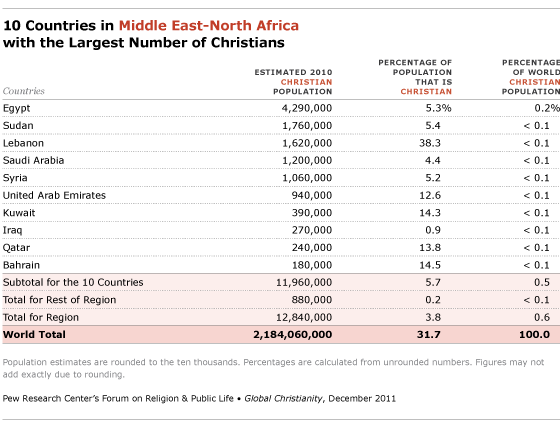
The Middle East-North Africa region is home to less than 1% of the world’s Christians.14 Only about 4% of the region’s residents are Christian. Although Christianity began in this region, it now has the lowest overall number of Christians and the smallest share of its population that is Christian. Christians are a minority in every country in the region. About half (47%) of all Christians in the region live in either Egypt or Sudan. Lebanon has by far the highest percentage of Christians (38%) in the region. The only other countries in the region where more than 10% of the population is Christian are the Gulf states of Bahrain, Kuwait, Qatar and the United Arab Emirates.

About 44% of Christians in the region are Catholic, including many Eastern-rite Catholics. Roughly the same proportion (43%) are Orthodox Christian. More than one-in-ten are Protestant (14%).
 Spotlight on EgyptNo nation in the Middle East-North Africa region has a larger Christian community than Egypt. Though media reports sometimes suggest that Christians make up 10% or more of Egypt’s population of approximately 80 million people, census and survey data analyzed for this report indicate that Egypt’s Christian population is about half that size. The study finds that there are 4.3 million Christians in Egypt — more than in Lebanon, Saudi Arabia and Syria combined. Nine-in-ten Egyptian Christians are Orthodox Christian. Most Christians in Egypt belong to the Coptic Orthodox Church, which is an Oriental Orthodox church.1 (See Defining Christian Traditions.)
Census and demographic survey data suggest that the Christian share of Egypt’s total population has been declining.2 The highest share reported in the past century was in 1927, when the census found that 8.3% of Egyptians were Christian. In each of the eight subsequent censuses, the Christian share of the population gradually shrank.3 The most recent census, in 2006, found that about 5% of the population was Christian. The Pew Forum’s 2011 report on the global Muslim population estimated that approximately 95% of Egyptians were Muslim in 2010.4
Although Egypt’s Christian population is overwhelmingly Orthodox, other Christian denominations and movements have a significant presence in the country. For example, there are an estimated 140,000 Egyptian Catholics and more than 250,000 Egyptian Protestants. Evangelical, pentecostal and charismatic movements have influenced Protestantism in Egypt, leading, for example, to the formation of the Coptic Evangelical Organization for Social Services, founded by evangelical layman Samuel Habib in 1950 to promote community development.5
Footnotes:
1 “July-December, 2010 International Religious Freedom Report,” U.S. State Department. (return to text)
2 Of course, it is possible that Christians in Egypt have been undercounted in censuses and demographic surveys. According to the Pew Forum’s August 2011 report Rising Restrictions on Religion, Egypt has very high government restrictions on religion as well as very high social hostilities involving religion. These factors may lead some Christians, particularly converts from Islam, to be cautious about revealing their faith. Government records may also undercount Christians. According to news reports, for example, some Egyptian Christians have complained that they are listed on official identity cards as Muslims. For more information, see http://pewresearch.org/pubs/1770/ask-the-expert-pewresearch- center#christians-egypt. (return to text)
3 Data on fertility patterns in Egypt support census accounts of a declining Christian population share. For decades, Christian fertility in Egypt has been lower than Muslim fertility. See Youssef Courbage and Philippe Fargues (1997), Christians and Jews Under Islam, I.B. Tauris & Co. Translated by Judy Mabro, p. 200; see also Elana Ambrosetti and Nahid Kamal (2008), “The Relationship between Religion and Fertility: The Case of Bangladesh and Egypt.” Paper presented at the 2008 European Population Conference. (return to text)
4 Pew Research Center’s Forum on Religion & Public Life, The Future of the Global Muslim Population: Projections for 2010-2030, 2011. (return to text)
5 Paul Rowe, “Building Coptic Civil Society: Christian Groups and the State in Mubarak’s Egypt,” Middle Eastern Studies, Volume 45, Issue 1, 2009, page 120. (return to text)
Footnotes:
8 To view all the countries and territories in the Americas, see the Interactive Maps. (return to text)
9 To see all the countries and territories in Europe, see the Interactive Maps. (return to text)
10 To see how Russia ranks globally on government restrictions on religion and social hostilities involving religion, see Pew Research Center’s Forum on Religion & Public Life, Rising Restrictions on Religion, 2011. (return to text)
11 To see all the countries and territories in Sub-Saharan Africa, see the Interactive Maps. (return to text)
12 African Independent Churches are Christian churches in sub-Saharan Africa that developed and function outside the control of Western missions or churches. Some AICs (also called African Initiated, Indigenous or Instituted Churches) incorporate aspects of traditional African religions, including revelatory dreams and visions, healing practices and belief in a spirit world. For more information, see Pew Research Center’s Forum on Religion & Public Life, Tolerance and Tension: Islam and Christianity in Sub-Saharan Africa, 2010. (return to text)
13 To see all of the countries and territories in Asia and the Pacific, see the Interactive Maps. (return to text)
14 To see all the countries and territories in the Middle East and North Africa, see the Interactive Maps. (return to text)

